AI in Medical Practice: How Doctors Are Reducing Documentation Work in 2026
Introduction: the paperwork problem in modern medicine
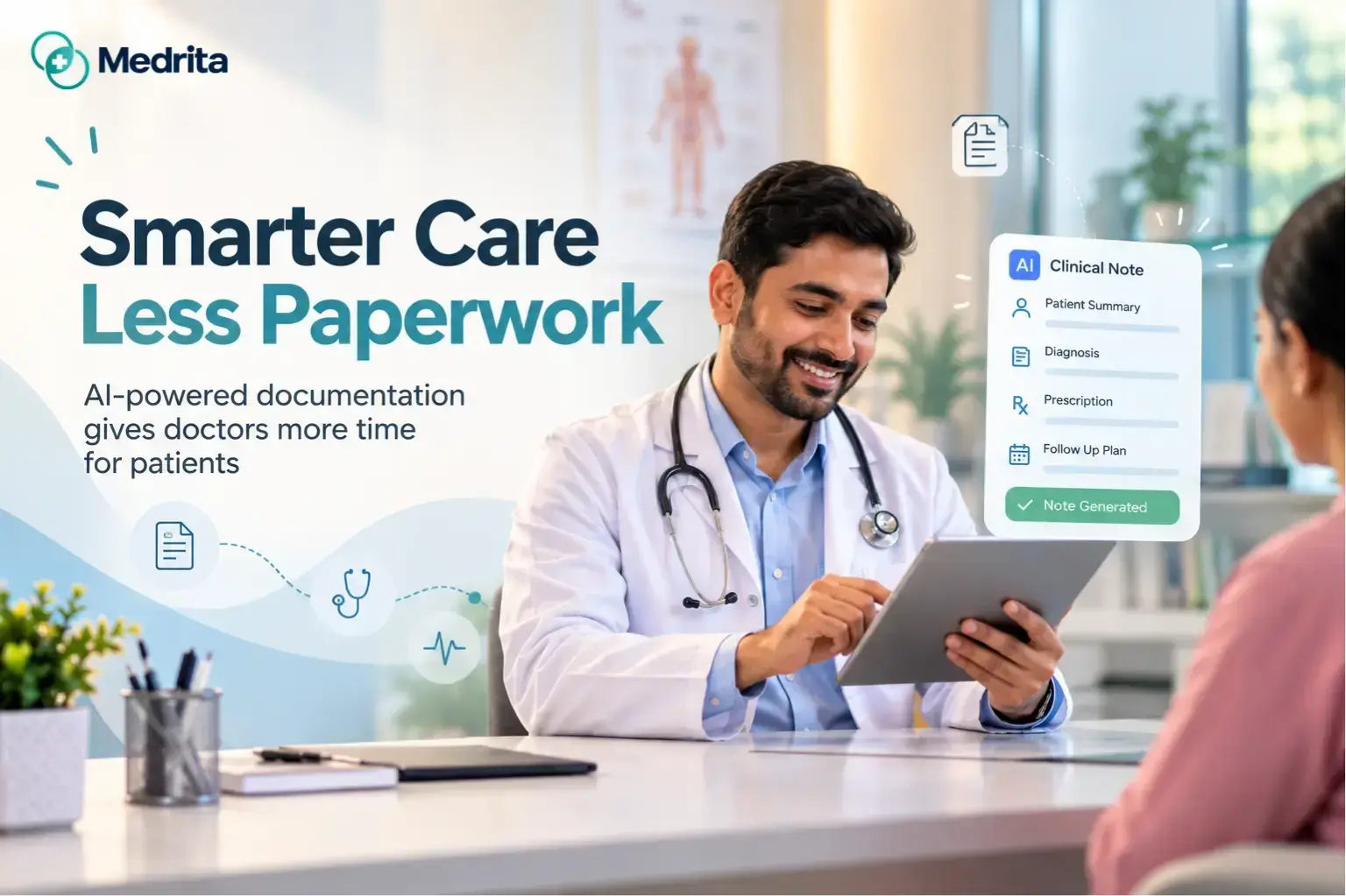
AI in medical practice is no longer a future promise. In 2026, it is how a growing number of doctors reduce documentation work and get back to patients. Clinical notes, prescriptions, follow-up reminders and records still have to be written, but they no longer have to consume the doctor's evening.
For most clinicians, documentation is the most time-consuming part of the day after patient care itself. Every consultation produces vitals, complaints, history, a diagnosis, a prescription, dietary advice and a follow-up plan. Multiply that by forty or sixty patients, across one or several branches, and the paperwork quickly outgrows the clinic hours.
This article explains how AI medical documentation works, what Indian regulations expect from digital records, and how Medrita, an AI-powered clinic management software and clinic management app, helps doctors record a complete consultation in minutes. It also offers a practical adoption plan and answers the questions doctors ask most often.
Why documentation burden matters: the facts
Documentation is not optional, and its volume keeps growing. Regulators, insurers and patients all expect complete, retrievable records. The key facts every practice should know:
- Record retention is a legal duty. Under clause 1.3 of the Indian Medical Council (Professional Conduct, Etiquette and Ethics) Regulations, 2002, physicians must keep indoor patient records for three years from the start of treatment. The same regulations say efforts shall be made to computerise records for quick retrieval.
- Records must be issued within 72 hours. When a patient, authorised attendant or legal authority requests records, they should be acknowledged and issued within 72 hours. Paper files make this deadline hard to meet.
- Digital signatures are now explicitly supported. On 13 October 2026, the National Medical Commission issued a clarification on remote authentication of medical records through digital or electronic signatures. It confirms there is no prohibition under the NMC Act, 2019, provided the doctor reviews the record personally and the facility maintains audit trails, logs and timestamps.
- India is building a national digital health backbone. The Ayushman Bharat Digital Mission (ABDM), run by the National Health Authority, connects patients, facilities and professionals through interoperable digital records and the ABHA health ID. As early as December 2021, the ABDM portal already reported more than 14 crore Health IDs created.
- Paperwork drives burnout worldwide. A widely cited 2016 study in Annals of Internal Medicine found that physicians spent roughly two hours on electronic records and desk work for every hour of direct patient care.
The conclusion is clear. Doctors cannot document less, so they must document smarter. That is where AI clinical documentation fits.
What is AI medical documentation?
AI medical documentation is the use of artificial intelligence to draft, organise and retrieve clinical records, so that doctors review and approve notes instead of writing them from scratch. The doctor stays in control; AI handles the repetitive structure.
In 2026, AI in medical practice reduces documentation work in four main ways:
- AI-generated clinical notes. The doctor enters the key findings, and AI drafts structured clinical notes that the doctor reviews and edits.
- Structured, template-driven EMR. Consultation screens capture vitals, complaints, diagnosis and prescriptions in consistent fields, so nothing is typed twice.
- Automated patient communication. Confirmations, reminders and follow-up messages go out automatically by WhatsApp and email, removing phone calls and manual notes from the front desk.
- Conversational access to clinic data. Doctors and managers ask an AI assistant a plain-language question and get an answer from their own records, rather than searching through files.
The World Health Organization's guidance on the ethics and governance of AI for health, which covers large multi-modal models, stresses that such tools must support, not replace, clinical judgement. Good clinical documentation software follows the same principle: AI drafts, the clinician decides.
How Medrita reduces documentation work for doctors
Medrita is AI-powered clinic management software that connects patient registration, appointments, consultations, prescriptions, treatment plans and inventory in one place, so each piece of information is entered once and reused everywhere. Here is how each feature removes documentation effort.
1. AI-generated clinical notes in every consultation
The Appointment Details screen is where the doctor records the visit. It captures vital signs (weight, temperature, pulse, blood pressure and SpO2), chief complaints, medical history and diagnosis in structured fields.
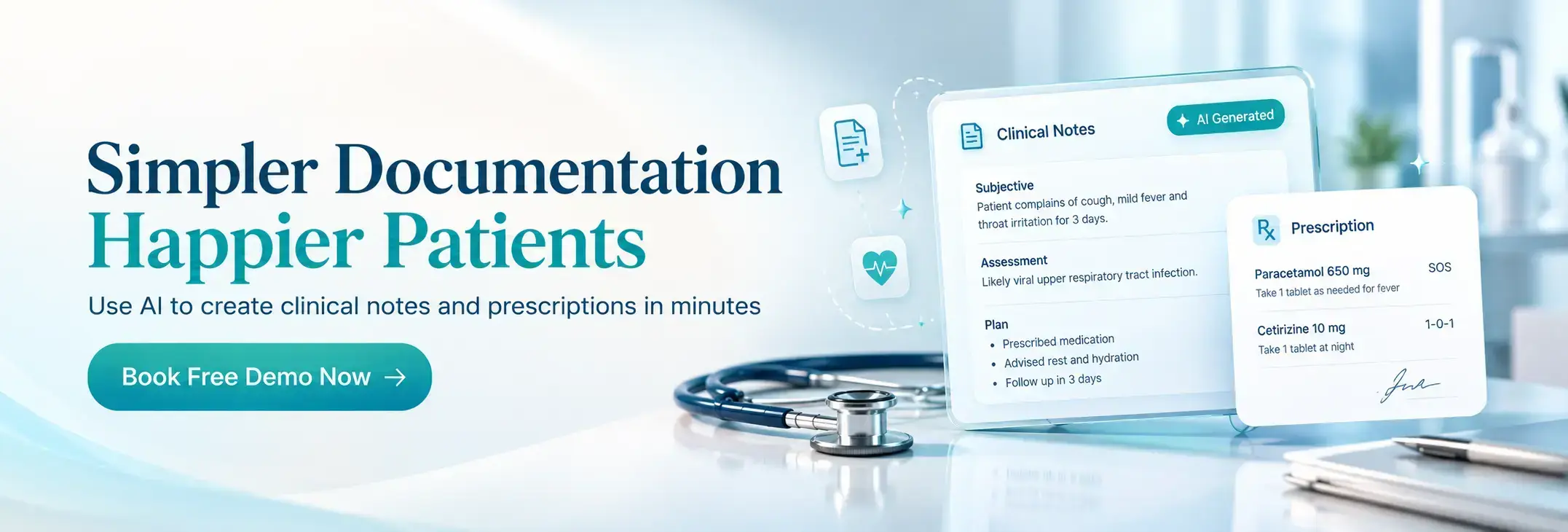
With one tick on Generate Clinical Notes with AI, Medrita drafts the clinical notes from what the doctor has entered. The doctor reviews, edits and approves them. This keeps notes complete and consistent without the doctor composing every sentence.
2. AI prescription software: digital prescriptions in a few clicks
Prescriptions are built line by line: medicine, dose, frequency (for example, twice daily), number of days and timing (for example, after breakfast). Doctors add treatments, patient instructions, foods to eat and avoid, and the next visit date. A Preview step lets them check everything before they select Generate Prescription.
The result is a clean, legible prescription with no handwriting errors, stored automatically against the patient record. This is what sets dedicated AI prescription software apart from a typed template.
3. A single patient record with full history
Every patient receives a unique health ID (UHID) at registration. The patient record holds contact details, blood group, weight, height, allergies, existing conditions and visit totals, with tabs for appointments, treatments, prescriptions and family members.
During a consultation, the patient's earlier visits appear beside the current one. The doctor sees history at a glance instead of asking the same questions again. Allergies and conditions are picked from standard master lists, which keeps records clean and searchable.
4. Treatment plans for multi-session care
For care that runs over several sessions, such as a root canal or a course of physiotherapy, doctors create a treatment plan directly from the consultation. The diagnosis and notes are copied in automatically. The plan tracks each session's date, duration, doctor, amount and status until it is marked complete.
5. Automated appointment software that documents itself
Booking an appointment pre-fills the consultation fee from the doctor's branch settings, offers only free slots and records whether the visit is fresh or a follow-up, walk-in or scheduled. Each visit carries a timeline: booked, patient arrived, completed. That is an automatic audit trail with no manual logging.
6. Automated reminders and patient notifications
Medrita sends confirmations by email and WhatsApp when an appointment is booked, rescheduled, cancelled, checked in or completed. Automated reminders cover upcoming appointments, follow-ups, overdue check-ins and birthday greetings. Patients can also book, cancel and reschedule on WhatsApp. Reception teams spend less time on calls and paper registers. Together, these features make Medrita a complete online appointment booking system with WhatsApp appointment booking built in.
7. Clinical supplies and inventory updated at the point of care
When a doctor logs supplies used during an examination, Medrita deducts them from inventory automatically. Stock for medicines, medical equipment and clinical supplies stays current without a separate stock register, giving the clinic built-in inventory management.
8. Ask your clinic data questions with Claude or ChatGPT
Medrita now connects with AI assistants such as Claude and ChatGPT through the Model Context Protocol (MCP). Once connected in Settings, an authorised user can ask questions in plain language, for example, "How many follow-up visits are due this week?", and get answers from the clinic's own patient and appointment data. Each connection shows who added it, its branch, its access level and when it was last used.
This is one of the most practical uses of AI for doctors in India today: reporting and lookup work that once took hours now takes a question.
9. Built for multi-doctor, multi-branch clinics
Doctor profiles store qualifications, registration numbers, branches, fees and working hours. A shared schedule view shows who is available where. Settings for allergies, conditions, procedures and templates feed every screen, so standards stay consistent across the whole practice. This makes Medrita scalable clinic management software for single clinics, polyclinics and growing chains.
10. Expense management for clinic owners
Medrita also works as expense management software for clinics. Expenses are organised under categories set up in Settings, so owners can see where money goes alongside appointments, fees and inventory. Keeping clinical, operational and financial records in one clinic management app removes yet another spreadsheet from the week.
Compliance, privacy and India's digital health framework
Using AI in a clinic is safe when the software protects patient data, keeps the doctor in control and maintains a clear audit trail. In India, three broad expectations shape this in 2026.
Patient privacy comes first. India now has clear data protection rules that apply to every clinic. In simple terms, patients must know why their data is collected, clinics should collect only what they need, and records must be kept secure. Patients can ask to see or correct their information, and they must be told promptly if their data is ever exposed.
The doctor stays responsible. India's medical regulator recognises digital records and digital signatures. Going digital does not change the doctor's responsibility, though. The doctor must still review every record personally, and clinics should keep a clear history of who did what and when.
Healthcare is becoming connected. The government's national digital health mission aims to give every citizen a digital health ID. It also lets records move securely between hospitals and clinics with the patient's consent. Clinics that digitise their records today will be better prepared for this connected future.
Medrita's design reflects these principles. AI drafts notes, but the doctor reviews and generates the final prescription. Visits carry a timestamped timeline. Patient records sit in one structured system rather than in scattered paper files, and AI assistant connections are listed with their owner, branch, access level and last use. Clinics should still review their own consent notices and data policies against India's data protection rules with legal advice.
What changes in the clinic: before and after AI documentation
The biggest gain is not a single feature but the removal of duplicate entry: information captured once at booking or consultation flows into prescriptions, treatment plans, reminders and inventory.
| Task | Traditional workflow | With Medrita |
|---|---|---|
| Clinical notes | Typed or handwritten after each visit | AI drafts notes; doctor reviews and approves |
| Prescriptions | Handwritten, prone to legibility errors | Structured digital prescription with preview |
| Patient history | Searched in paper files or old registers | Shown beside the current consultation |
| Follow-ups | Front desk calls patients manually | Automated WhatsApp and email reminders |
| Fees and billing | Entered separately at reception | Pre-filled from the doctor's branch settings |
| Supply tracking | Separate stock register | Deducted automatically when logged in a visit |
| Reports and lookups | Manual counting and spreadsheets | Plain-language questions via Claude or ChatGPT |
For doctors, this means shorter after-hours charting and more attention in the consulting room. For clinic owners, it means fewer missed follow-ups, cleaner records and better visibility across branches. For patients, it means clear prescriptions and timely reminders.
How to adopt AI documentation in your practice
Clinics get the best results by digitising the foundations first, then switching on AI features once the data is clean. A practical sequence with Medrita:
- Set up doctors and branches. Add each doctor's qualification, registration number, fees, slot duration and working hours.
- Build your master lists. Add allergies, conditions and procedures in Settings so every record uses the same terms.
- Register patients and move bookings online. Every patient gets a UHID, and family members are linked by mobile number.
- Switch on notifications and reminders. Choose WhatsApp, email or both for each event, and customise the messages.
- Start recording consultations digitally. Use structured vitals, diagnosis and prescription fields, then enable AI-generated clinical notes.
- Connect an AI assistant. Link Claude or ChatGPT through MCP so authorised staff can query clinic data.
- Review and refine. Check that AI drafts match your clinical style and that consent notices meet DPDP requirements.
Frequently asked questions
How can doctors reduce documentation time in 2026?
Doctors reduce documentation time by using structured EMR screens, AI-generated clinical notes, digital prescriptions and automated patient reminders. Platforms such as Medrita capture information once and reuse it across the patient record, prescriptions and follow-ups.
Does AI replace the doctor's judgement in clinical notes?
No. In Medrita, AI drafts clinical notes from the doctor's entries, and the doctor reviews and approves them before generating the prescription. NMC guidance also confirms that responsibility for authenticated records stays with the registered medical practitioner.
Is AI clinical documentation legal in India?
Yes, when used responsibly. Electronic records and digital signatures are supported under the IT Act, 2000, and the NMC's October 2026 clarification confirms remote digital authentication is not prohibited. Clinics must also comply with the DPDP Act, 2023 and DPDP Rules, 2025.
How long must Indian doctors keep medical records?
Under the 2002 professional conduct regulations, now administered by the NMC, indoor patient records must be kept for three years from the start of treatment, and copies must be issued within 72 hours of a valid request.
Can patients book appointments on WhatsApp with Medrita?
Yes. Patients can book, cancel and reschedule their own appointments on WhatsApp. They also receive confirmations and reminders by WhatsApp or email.
Can I use ChatGPT or Claude with my clinic data?
Yes. Medrita connects with Claude and ChatGPT through the Model Context Protocol (MCP), so authorised users can ask questions about patients and appointments in plain language.
Is Medrita suitable for multi-branch clinics?
Yes. Medrita supports multiple doctors and branches, with branch-wise fees, schedules, appointments and AI assistant connections.
What should I look for in clinic management software?
Look for one platform that combines automated appointment software, AI prescription software, electronic patient records, WhatsApp reminders, inventory tracking and expense management. A clinic management app that connects all of these, as Medrita does, removes duplicate data entry and saves the most documentation time.
What is AI medical documentation software, and how does it work in a clinic?
AI medical documentation software drafts clinical records from the consultation, so doctors review notes instead of typing them. In Medrita, voice-to-notes transcribes the visit and structures it into chief complaint, history, examination, diagnosis and plan. The doctor reviews, edits and accepts the draft before it is saved to the patient's record.
How can doctors reduce paperwork without compromising the quality of patient records?
Doctors can reduce paperwork by capturing information once in structured fields and letting AI draft the routine text, while keeping review in their own hands. Structured records stay consistent and searchable. With AI medical documentation software, every draft note and prescription should still be checked, corrected and approved by the doctor before it is saved.
Can AI turn a doctor’s voice notes into structured clinical documentation?
Yes. Medrita's voice-to-notes transcribes the consultation in real time and extracts a structured note with chief complaint, history, examination findings, diagnosis, plan and follow-up. The result is a draft: the doctor reviews it, edits anything that needs correcting and then accepts it. The audio is processed and discarded; the approved note is stored.
What is the difference between AI medical documentation software and a traditional EMR?
A traditional EMR stores records that doctors and staff type in manually. AI medical documentation software adds a drafting layer: it turns the consultation into a structured note and suggests prescription details for the doctor to review. The record still lives in the patient file, but far less of it has to be written from scratch.
How can AI reduce duplicate data entry across clinical notes, prescriptions and follow-ups?
AI reduces duplicate entry when notes, prescriptions and follow-ups share one patient record. In Medrita, an accepted clinical note attaches to the booking and appears in the patient's record, the prescription assistant suggests a follow-up date, and automated messages handle reminders and follow-up scheduling. Information entered once is reused rather than retyped.
What should doctors check before approving AI-generated clinical notes?
Doctors should check that the AI-generated note matches what actually happened: complaint, history, examination findings, diagnosis, medicines, doses and follow-up. They should remove anything the patient did not say, add clinical judgement the draft missed and confirm allergies. The note becomes part of the record only after the doctor approves it.
How does an AI prescription assistant work alongside clinical documentation?
An AI prescription assistant works from the same patient record as the clinical note. In Medrita, it suggests medicines from the doctor's own prescribing patterns, auto-fills dosage by age and weight, checks recorded allergies and current medications, and proposes a follow-up date. The doctor reviews every suggestion and signs the final prescription.
Can AI summarise a patient’s medical history before a consultation?
Partly, depending on the software. In Medrita, patients who book online can describe their symptoms, and the doctor receives a structured pre-visit summary attached to the booking. The patient record also shows past visits, notes, prescriptions, allergies and conditions in one place. Doctors should still confirm the history directly with the patient.
How can automated follow-up reminders reduce administrative work in clinics?
Automated reminders replace manual phone calls and paper registers at the front desk. Medrita sends confirmations, reminders, pre-visit instructions, post-visit care notes and follow-up messages automatically, including 24-hour and 1-hour reminders, with extra nudges for higher-risk patients. Staff spend less time chasing patients, though the effect varies from clinic to clinic.
What patient privacy safeguards should clinics look for in AI medical documentation software?
Clinics should look for encryption, strict separation between clinics, permission checks, audit logs and clear AI data rules. Medrita encrypts data in transit and at rest, isolates each clinic's data, logs every record change, offers optional PII masking before AI calls and never uses patient data to train models. Clinics still need their own DPDP consent notices.
Which features should Indian clinics compare when choosing AI medical documentation software?
Indian clinics should compare how the software drafts notes, how easily doctors can review and edit them, prescription safety checks, a single patient record, audit trails, data storage location and DPDP Act readiness. Medrita, for example, stores primary data for Indian clinics in AWS Mumbai. Test any AI medical documentation software in a live demo first.
How can a small clinic move from paper records to AI-assisted documentation?
Start small. Set up doctors and working hours, then create digital patient records as patients visit instead of converting every old file at once. Add structured consultation notes and digital prescriptions next, and switch on AI drafting once the team is comfortable. Doctors should keep reviewing every AI draft before approving it.
How does Medrita help doctors manage clinical notes and digital prescriptions?
Medrita links clinical notes and prescriptions to one patient record. Voice-to-notes drafts a structured note for the doctor to edit and accept, and the prescription assistant suggests medicines, dosage and follow-up dates with allergy and interaction checks. Each note and prescription is attributed to the doctor and visible in the patient's history.
How can clinic owners measure whether Medrita reduces documentation time?
Measure before and after. Record how long doctors spend on notes and prescriptions per patient, and how much charting happens after clinic hours. Repeat the same measurement a few weeks after adopting Medrita. Medrita also tracks actual consultation times per doctor, which helps owners compare patterns. Results vary, so rely on your own data.
Conclusion: give doctors their time back
AI in medical practice is changing what a clinical day looks like. Documentation remains essential for patient safety, legal compliance and continuity of care. But in 2026 it no longer has to be manual, repetitive or taken home at night.
With AI-generated clinical notes, AI prescription software, automated appointment scheduling, connected patient records, automated reminders, inventory and expense management, and AI assistant integration, Medrita helps doctors spend less time on paperwork and more time with patients. It does this while keeping the clinician firmly in control.
Ready to reduce documentation work in your clinic? Book a demo of Medrita and see how AI clinical documentation fits into your practice.